Buyer guide
Vietnamese vs Indian vs Chinese Hair: A Wholesale Buyer's Guide
Vietnamese, Indian and Chinese hair are each linked with a typical look: Vietnamese hair is usually described as straight and strong, Indian hair as finer with a natural wave, and Chinese hair as straight and coarse. For a wholesale buyer, origin is a starting point rather than a guarantee, because how the hair is sorted, processed and drawn decides more about a bundle than the country it came from.
Key takeaways
- Vietnamese hair is usually described as straight to slightly wavy with strong, smooth strands.
- Indian hair is usually described as finer to medium strands with a natural wave or curl.
- Chinese hair is usually described as straight and coarse, and the name is also used for hair processed in China.
- Names such as Brazilian, Peruvian and Malaysian are often used as texture or product names rather than the place the hair grew.
- No visual check proves where hair came from; samples of the same specification tested side by side show what you would actually receive.
- Compare hair from different origins at the same length, weight, drawn grade and texture, or the comparison says more about the specification than the origin.
What is the difference between Vietnamese, Indian and Chinese hair?
The usual difference is natural texture and strand feel: Vietnamese hair is mostly straight with strong strands, Indian hair often has a natural wave and a lighter feel, and Chinese hair is mostly straight and coarse. These are tendencies across many donors, not rules for every bundle.
| Origin or name | How it is usually described | What to verify on your sample |
|---|---|---|
| Vietnamese | Straight to slightly wavy, smooth, strong strands; wavy and curly textures are usually steamed from straight hair | Whether the texture is natural or steamed, and whether the ends stay full at the length you need |
| Indian | Finer to medium strands with a natural wave or curl; widely available, including hair offered at temples | How the natural pattern behaves after washing, and how many short hairs the bundle contains |
| Chinese | Straight, coarse and dense; China is also a large centre for processing hair grown elsewhere | Whether the label means where the hair grew or where it was processed, and whether a coating gives the shine |
| Cambodian and Burmese | Often wavy, with a medium to coarse feel, and sold in smaller volumes | Whether a re-order can match the first lot in texture and colour |
| Brazilian, Peruvian, Malaysian | Often used as names for a texture or a product line rather than the country the hair grew in | Where the hair was collected and processed, stated in writing |
Words such as raw, virgin and Remy describe processing and cuticle direction, not origin, so a bundle from any country can be raw or heavily processed.
Why do sellers disagree about which hair is better?
Sellers disagree because most comparisons are written by companies that sell one origin, and because hair varies more between donors and processing methods than between countries. One seller guide calls Vietnamese hair thicker than Chinese hair, while another says the opposite.
Three things blur most origin comparisons. The specification differs: a double drawn bundle feels fuller than a single drawn one from any country. The processing differs: steaming, colouring and silicone change the feel more than origin does. And the claims are hard to check: lifespan figures depend on care and use, so treat a promised number of years as marketing rather than a specification.
A fair comparison therefore keeps everything equal except the origin: same length, same weight, same drawn grade, same texture and the same tests.
Which hair origin suits which wholesale product line?
Choose by the product you sell and its texture, then ask which hair the supplier uses for it. Origin helps most when the texture you sell is close to the hair's natural pattern, because the hair then needs less processing to reach it.
| Product line | Natural texture that needs the least processing | Question to ask any supplier |
|---|---|---|
| Bone straight and sleek straight bundles or wigs | Naturally straight hair, often sold as Vietnamese or Chinese | Is this naturally straight, or straightened chemically or with heat? |
| Natural wave and loose wave lines | Hair with a natural wave, often sold as Indian, Cambodian or Burmese | Will the wave return after washing without product? |
| Curly and kinky textures | Most curly textures in the trade are steamed from straight or wavy hair | Which steaming method is used, and how does the curl hold after several washes? |
| Blonde and fashion colours | Hair with strong strands and a healthy cuticle, whatever the origin | Can I test-lift a strand from this lot, and what colour level did it reach? |
If you sell one texture across several product types, buying all of it from one origin and one supplier makes shade and texture easier to keep consistent between re-orders.
How do you compare hair samples from different origins side by side?
Order the same specification from each supplier, hide the labels and run the same tests on every sample at the same time. A side-by-side test removes most of the guesswork that origin labels leave.
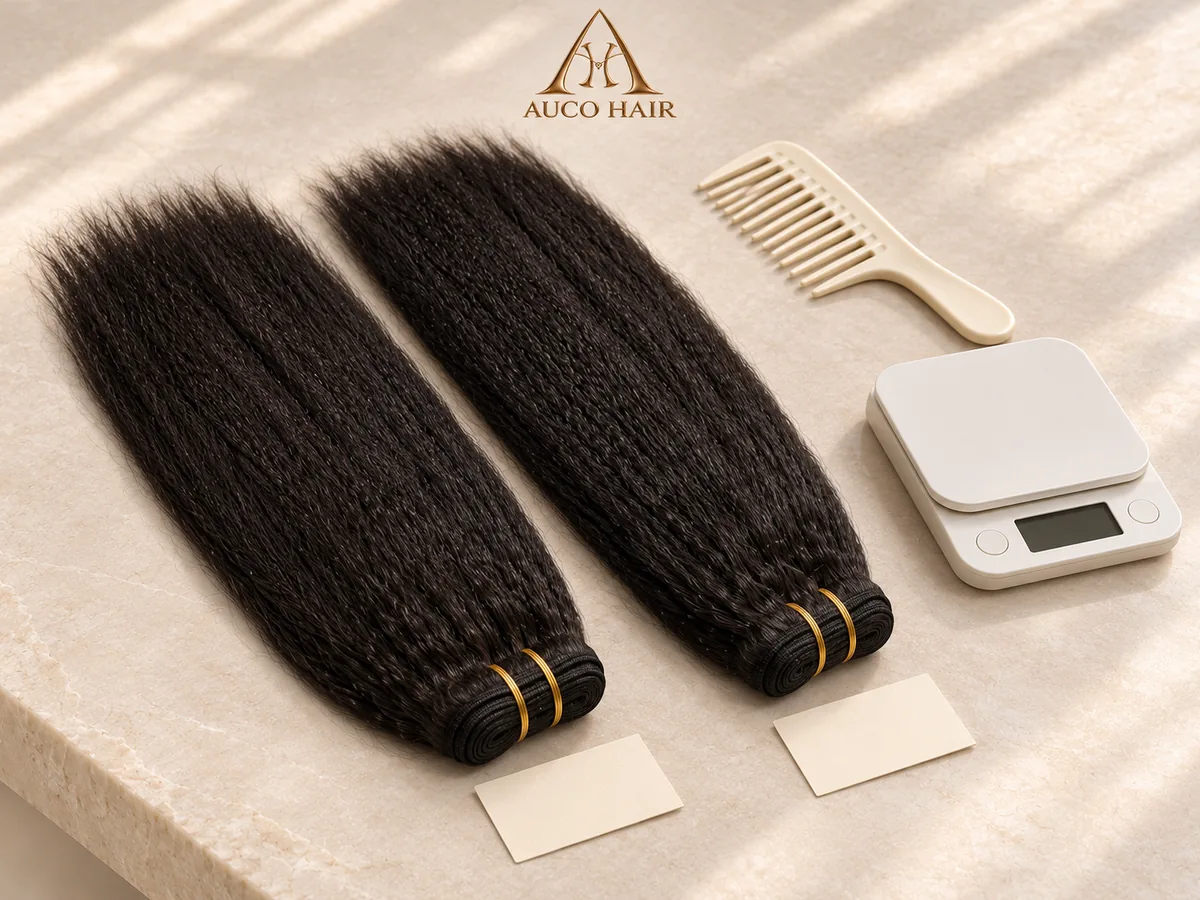
| Step | How to do it | What it shows | What it cannot show |
|---|---|---|---|
| Match the order | Ask every supplier for the same length, weight, drawn grade, texture and colour | Differences that remain come from the hair, not the order | Whether the supplier can repeat the sample in bulk |
| Code the samples | Replace each label with a code and record which is which | An opinion that is not swayed by the origin name | Origin itself |
| Weigh and measure | Weigh each bundle and measure it stretched straight from the weft or band | Whether each sample matches what was ordered | Fullness at the ends, which needs its own check |
| Wash and air-dry | Wash all samples together with a plain shampoo and no conditioner, then dry without heat | The feel and texture without coatings | How the hair behaves after months of wear |
| Style and colour | Flat iron and curl one strand from each sample, and test-lift one strand if you sell colour | How each sample takes heat and colour | The result on every bundle of a bulk order |
| Rank, then reveal | Rank the samples for your product before uncovering the codes | Which supplier's hair suits your line | Long-term consistency, which only re-orders prove |
Keep the winning sample sealed and dated as the reference for the first bulk order and every re-order.
How can you check where a supplier's hair really comes from?
You cannot confirm origin by looking at, touching or burning hair, so check the supplier instead: where the hair is collected, where it is sorted and processed, and what the shipping documents say. A supplier that prepares hair itself can answer these questions directly.
- In which country was this hair collected, and in which country was it sorted and processed?
- Is the texture natural, or was it steamed or chemically changed, and where was that done?
- Is this lot from one origin only, or blended with hair from other countries?
- Which country of origin will appear on the commercial invoice and shipping documents?
- If I re-order the same code, will the hair come from the same origin and the same preparation process?
- Can I visit or video-call the place where my order is prepared?
Write the answers into your order specification. If a later shipment does not match the agreed origin or processing, you then have a written agreement to point to.
Where does AUCO HAIR's hair come from?
AUCO HAIR sells Vietnamese human hair. The hair is sorted, processed, checked and packed in Hiep Hoa, Bac Ninh, Vietnam, and the AUCO team handles each order directly from specification to delivery.
If you are comparing Vietnamese hair with hair from another origin, send AUCO HAIR the specification you buy today. AUCO can arrange a sample matched to that length, weight, drawn grade and texture where possible, so you can run the side-by-side test in this guide.
Frequently asked questions
Is Vietnamese hair better than Indian hair?
Neither is better for every product. Vietnamese hair is usually chosen for straight and sleek lines because of its strong, straight strands, and Indian hair for natural wave lines because of its natural pattern. Compare samples of the same specification to decide for your own products.
Does Brazilian or Peruvian hair come from Brazil or Peru?
Not necessarily. In the hair trade, names such as Brazilian, Peruvian and Malaysian are often used for a texture or a product line. Ask the supplier to state in writing where the hair was collected and where it was processed.
Can you tell where hair comes from by looking at it?
No. Texture, strand thickness and shine vary between donors from the same country, and processing changes all three. Tests such as washing or burning a strand show how hair behaves, not where it grew, so origin has to be checked with the supplier.
Why do prices differ between Vietnamese, Indian and Chinese hair?
Prices depend on the whole specification, such as grade, length, drawn grade, texture and colour, as well as on supply. Compare quotes for the same specification from each supplier, rather than comparing country names.
Can AUCO HAIR make a sample to compare with my current hair?
Yes. Send the length, weight, drawn grade, texture and colour you buy today through the wholesale form or on WhatsApp at +84 986 008 888, and AUCO HAIR can arrange a Vietnamese hair sample matched to it where possible for a side-by-side test.
Start a conversation
Ready to source Vietnamese hair?
Send your shortlist and estimated quantities. AUCO replies with current wholesale information.